Westhouses Primary School
Religious Education
Religious Education
As a school, we have adopted the 2025-2030 locally agreed Derbyshire syllabus for Religious Education. RE must be provided for all registered pupils in state-funded schools in England, including those in the sixth form, unless withdrawn by their parents (or withdrawing themselves if they are aged 18 or over). If parents wish to withdraw their child from Religious Education, they must contact the headteacher in writing. RE is a necessary part of a ‘broad and balanced curriculum’. As a Local Authority school, we must follow the Derbyshire County Council Agreed Syllabus. The RE curriculum is drawn up by the Standing Advisory Council on Religious Education (SACRE), and ‘shall reflect the fact that the religious traditions in Great Britain are in the main Christian, while taking account of the teaching and practices of the other principal religions represented in Great Britain’ (Education Act, 1996).
Intent
• Religious Education contributes dynamically to children and young people’s education in schools by provoking challenging questions about meaning and purpose in life, beliefs about God, ultimate reality, issues of right and wrong and what it means to be human.
• In RE pupils learn about and from religions and worldviews in local, national and global contexts, to discover, explore and consider different answers to these questions.
• Pupils learn to weigh up the value of wisdom from different sources, to develop and express their
insights in response, and to agree or disagree respectfully.
• Teaching therefore should equip pupils with systematic knowledge and understanding of a range of religions and worldviews, enabling them to develop their ideas, values and identities.
• It should develop in pupils an aptitude for dialogue, so that they can participate positively in society, with its diverse religions and worldviews.
• Pupils should gain and deploy the skills needed to understand, interpret and evaluate texts, sources of wisdom and authority and other evidence. They should learn to articulate clearly and coherently their personal beliefs, ideas, values and experiences while respecting the right of others to differ.
Implementation
We follow the Derbyshire Agreed Syllabus. To support our teaching of this scheme, we supplement our lessons with Understanding Christianity and RE Today resources. Through their RE learning, pupils will explore big questions about life, in order to find out what people believe and what difference this makes to how they live, so that they can make sense of religion and worldviews, and reflect on their own ideas and ways of living.
The agreed syllabus requires that all pupils learn from Christianity in each key stage. In addition, pupils will learn from the principal religions represented in the UK, in line with the law. These are Islam, Hinduism, Sikhism, Buddhism and Judaism. Furthermore, children from families where non-religious worldviews are held are represented in almost all of our classrooms. These worldviews, including for example Humanism, will also be the focus for study. The main focus of our teaching is built up from the representation of faiths and beliefs within our community and wider local area.
Reception:
Children will encounter Christianity and other faiths, as part of their growing sense of self, their own community and their place within it.
Key Stage 1:
Christians, Muslims and Jewish people
Key Stage 2:
Christians, Muslims, Hindus and Jewish people, alongside other world views, such as Humanism and Spiritualism.
In order to deliver the aims and expected standards of the syllabus effectively, the expectation is that there is a minimum allocation of 5 percent of curriculum time for RE.
- In Reception, this equates to 36 hours of RE, e.g. 50 minutes a week or some short sessions implemented through continuous provision.
- In key Stage 1, this equates to 36 hours of tuition per year (e.g. an hour a week, or less than an hour a week plus a series of RE days).
- In Key Stage 2 this equates to 45 hours of tuition per year (e.g. an hour a week, or a series of RE days or weeks amounting to 45+ hours of RE).
Impact
Pupils are assessed periodically throughout units of learning, in accordance with our Teaching and Learning Policy. Each lesson, Teachers will use ongoing assessment to identify where children require additional support or challenge. Within lessons, activities will be adapted accordingly. Within planning, teachers shall ensure that lessons are progressive and build upon prior learning, recapping key concepts as appropriate. Planning will identify key success criteria, gathered from the Syllabus, and will identify what children should be doing to work towards, be expected or work at a greater depth. Units are structured in such a way to allow children to revisit and build upon prior learning - this will also support children who require additional support to achieve the end of unit goals. Opportunities will be planed for children to demonstrate their understanding in different ways, such as through art work, mathematics and extended pieces of writing.
Due to copyright, we are unable to publish the full scheme on our website. Please contact the office if you would like to view this.
Overview of Learning and Progression:
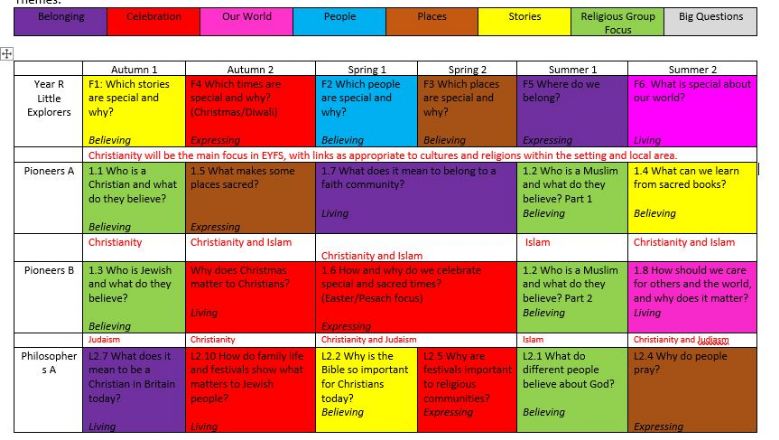
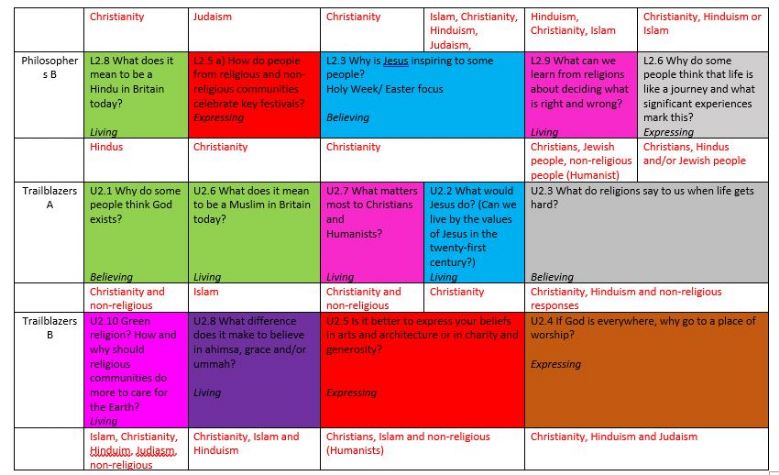
After reviewing the new syllabus, we have decided to structure our RE curriculum in a progressive way. Units at the beginning of each year will focus on specific religions and their beliefs, whereas units towards the end of the academic year will be thematic in approach, drawing together the knowledge and understanding gained from earlier units in the year and in previous years. Some units have also been split into two parts – this ensures that children will revisit key ideas periodically, embedding and developing understanding further.
The following table outlines the areas of learning, and specific religious links within the units. Each coloured block shows areas of learning which build upon one another - this may be through key religious knowledge (building upon prior knowledge or make comparisons) or specific themes where comparisons can be made within and across religions and beliefs.
Themes:
Religious Education Scheme of Learning
Subject on a Page